- Python Weekly
- Posts
- Python Weekly (Issue 750 June 18 2026)
Python Weekly (Issue 750 June 18 2026)

Rahul Chaudhary
June 18, 2026
In partnership with

Welcome to issue 750 of Python Weekly. Let's get straight to the links this week.
The AI Work Handbook That Cuts Your Workday in Half
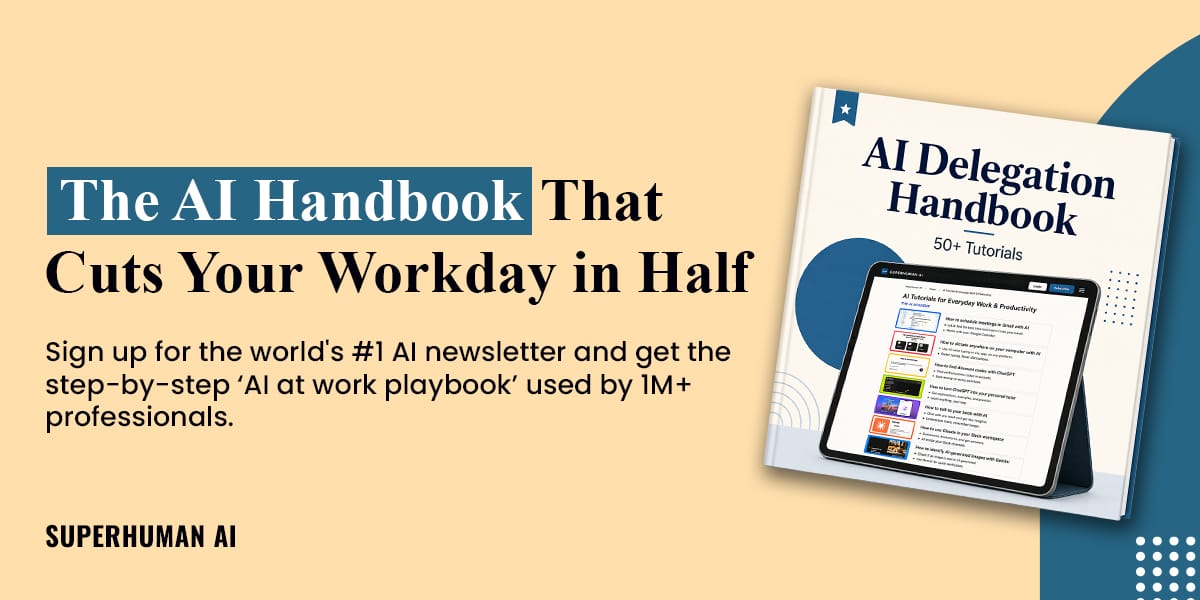
The 8-hour workday is becoming a 4-hour workday for people who know how to use AI.
Everyone else is still catching up.
This AI work playbook shows you exactly how to cut your work hours in half using AI.
Sign up for Superhuman AI and get:
50+ step-by-step AI tutorials to cut your workload in half — covering every part of your workday, from emails to strategy, used by 1M+ professionals at Google, Microsoft, and NASA
Superhuman AI newsletter (4 min daily) so you keep discovering new AI tools and skills to stay ahead in your career — the playbook is just the start
Articles, Tutorials and Talks
Python 3.14.0 introduced a new incremental garbage collector. But reports of higher memory usage caused the Python team to revert the garbage collector changes in 3.14.5. We investigate how memory management works in Python and workloads that perform best and worst for the incremental garbage collector.
Learn how to use Python's ast module to parse, transform, and execute code at runtime, using eval-type-backport as a real-world Python metaprogramming example.
The post shows how a Python dependency injection container was optimized from ~53 µs to 0.40 µs per resolve by caching plans, eliminating unnecessary checks, and compiling dependency graphs into generated code. Along the way, it demonstrates practical performance engineering techniques, including code generation, common-subexpression elimination, fuzz testing, and reproducible benchmarking
The post explains a modern Django approach to JavaScript using import maps, native browser modules, and a shared import map rendered by Django templates. It argues that import maps can eliminate the need for bundlers in many applications while still supporting cache-busted static assets and reusable third-party app JavaScript.
This comprehensive guide covers pytest from basic testing concepts to advanced techniques such as fixtures, parametrization, mocking, and asynchronous testing. It provides practical patterns for building maintainable, scalable Python test suites and leveraging pytest effectively in production environments.
This video explains why nested loops are often a design problem rather than an algorithmic necessity, typically resulting from poor data structures or misplaced responsibilities. Using a real-world refactoring example, it shows how restructuring code can reduce complexity and improve maintainability.
This article shows how to recreate core GitHub Pages functionality using only Python's standard library, including static file serving, automated deployments, and HTTPS support. By extending http.server in just a few dozen lines of code, it demonstrates how native Python tools can power a lightweight static website hosting platform.
This video explains how Django's internationalization framework enables applications to support multiple languages by detecting a user's active language and serving the appropriate translations. It also demonstrates the makemessages and compilemessages commands, along with common localization approaches such as language cookies and URL-based language prefixes.
Security researchers at elttam uncovered three critical vulnerabilities in Jupyter Enterprise Gateway that allow notebook users to escalate privileges and potentially take over an entire Kubernetes cluster. The post walks through the attack chain from a Jupyter notebook to cluster-wide compromise, highlighting the risks of running multi-tenant notebook infrastructure without strong isolation and patch management.
The post explains how Pluggy works as a reusable Python library for building plugin systems, centered on hooks that hosts define and plugins implement. It also highlights the design tradeoffs Pluggy handles well, including registration, signature validation, ordering, and hook wrappers, while leaving plugin discovery largely up to the application.
The post walks through profiling a PyTorch MLP and shows that nn.Linear already uses a fused addmm path, meaning much of the observed overhead comes from kernel launches and scheduling rather than redundant computation. The key takeaway is that meaningful speedups come from understanding which operations are already fused and reducing the number of GPU kernels per forward pass, rather than assuming torch.compile will always deliver performance gains.
The videos from PyData London 2026 are now available.
Interesting Projects, Tools, and Libraries
Framework for AI agents to build and maintain a digital brain through Obsidian wiki using Karpathy's LLM Wiki pattern.
AI-powered bug bounty hunting from your terminal - recon, 20 vuln classes, autonomous hunting, and report generation. All inside Claude Code.
Official, AWS-supported MCP servers, skills, and plugins to help AI agents build on AWS.
SIA is a Self Improving AI framework to autonomously improve the performance of any AI system (Model / Agent) on a benchmark task.
World's first open-source, agentic video production system. 12 pipelines, 52 tools, 500+ agent skills. Turn your AI coding assistant into a full video production studio.
tracesage adds local, zero-infra tracing to LangChain/LangGraph agents in two lines, it captures every chain, tool, and LLM call to SQLite and shows the run as a live graph and timeline in your browser. Open source, pip install, MIT licensed.
New Releases
Scikit-learn 1.9 release is out, and it comes with solid improvements to many existing estimators, making them faster, more stable, handling missing values, adding GPU support… The release also enhances the estimator displays in notebooks, and introduces a callback mechanism that opens the door to progress bars or advanced monitoring of convergence.
Upcoming Events and Webinars
There will be a talk, Getting Data from Anywhere: A Practical Introduction to APIs.
There will be a talk, Feed an AI-agentic beast with proper data.
There will be following talks
What Builders Need to Know About Securing Agent Access
How I Roast my Coworkers I just met with Python, Slack, and Google APIs
How to Land an AI Job in 30 Days (Without a PhD)
There will be following talks
Process geographical data in Python
Symbolic Differentiation of Matrices and N-Dimensional Arrays in SymPy
There will be following talks
NPS - Not Proper (data) Science?
Choosing projects under uncertain preferences for impacts
Learning Data Engineering (not) from scratch
There will be following talks
From Annotation to Deployment: Building an Object Detection Pipeline with Geti, YOLO26, and OpenVINO
Prompt, Pray, Pay: The New Economics of AI Coding Assistants
There will be following talks
Answers You Can Question: Building a Trustworthy Self-Service Analytics Agent
From chat to insight: reliable AI agents for financial data
There will be a talk, Robot-assisted Exoskeletons for Individuals with Spinal Cord Injury.
There will be following talks
Empathy Data in LLM's - Part II
The meaning of lift - understanding marketing effectiveness
Our Other Newsletters |
Programmer Weekly - A free weekly newsletter for programmers.
Founder Weekly - A free weekly newsletter for entrepreneurs featuring best curated content, must read articles, how to guides, tips and tricks, resources, events and more.